Answering Service Cost: 4 Pricing Models in 2026
Compare the four ways answering services bill you, see the price ranges publicly listed in 2026, and learn which hidden fees quietly double the invoice.

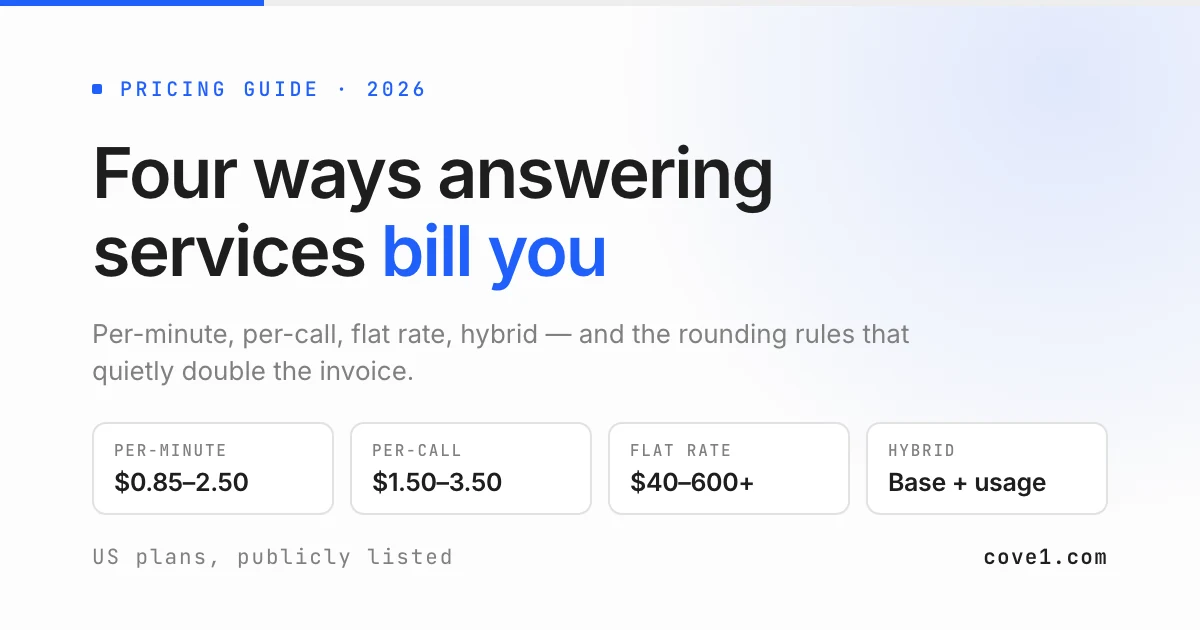
TL;DR: answering service cost in the US falls into four billing models, and the model matters more than the headline rate. Across publicly listed plans we reviewed in September 2026, per-minute plans are commonly quoted from about $0.85 to $2.50 per minute, per-call plans from about $1.50 to $3.50 per call, and flat rate monthly bundles from roughly $40 for a small starter block to $600 or more for a few hundred minutes. Budget against the overage rate and the rounding rule, not the advertised base plan.
Ask five providers how much do answering services charge and you get five quotes that look cheap on page one and expensive on the third invoice. That is rarely a bait-and-switch. It is a mismatch between how the provider meters work and how your callers behave. A plumbing company with forty ninety-second dispatch calls a month and a law firm with forty eight-minute intake calls a month can receive identical quotes and pay amounts that differ fourfold.
All figures below are ranges assembled from publicly listed US plans as of September 2026. They move with volume, complexity, industry, and contract length, and any provider may sit outside them. Treat them as a sanity band for judging a quote, not as a quote.
This page is about price mechanics — how the meter runs, across every industry. It deliberately does not rank vendors. If you already know your budget and the open question is which provider to buy, our roundup of property management answering services does the vendor-by-vendor comparison instead.
Why quotes are hard to compare
Two structural problems. The billable unit differs, so a call answering service cost of $1.29 per minute and one of $2.10 per call are not comparable until you know your average handle time. And the meter starts and stops in different places: some providers bill agent talk time only, others bill from the moment the call connects, including hold time, IVR time, and post-call wrap-up, which can swing telephone answering service costs by 20 to 40 percent on identical volume.
Model 1: per-minute billing
How it works. You buy a block of minutes, or pay per minute with no block, and every billable minute draws it down. Publicly listed per-minute rates in 2026 commonly sit between $0.85 and $2.50, the lowest attached to large committed volumes and the highest to small no-commitment accounts.
Who it suits. Short, transactional calls: appointment confirmations, message taking, simple dispatch. Under a two-minute average, per-minute billing usually produces the lowest phone answering service cost of the four models.
When the bill runs away. Rounding first: most per-minute providers round each call up to the next full minute, so forty callers who each talk for seventy seconds cost you 80 minutes, not 47. Then call length drift. Add an intake script, a disclaimer, or a warm transfer attempt and average handle time climbs by a minute. On 300 calls a month at $1.50, that one minute adds $450 to your answering service cost.
Model 2: per-call pricing
How it works. You pay a fixed amount per handled call regardless of length. Answering service per call pricing is commonly quoted in the range of $1.50 to $3.50 for straightforward message taking, and higher when the call includes order entry, scheduling, or protocol dispatch.
Who it suits. Businesses with long but infrequent calls, and businesses that need predictability more than the lowest unit rate. Per-call billing converts a variable business answering service cost into something close to a fixed cost per lead, which is easy to compare against your cost per acquisition.
When the bill runs away. Definitions. Ask exactly what counts as a billable call. Wrong numbers, robocalls, five-second hang-ups, and repeat calls from one caller inside a short window are billed by some providers and waived by others. A business with real spam volume can see 15 to 25 percent of billable events come from calls it never wanted answered. Per-call pricing also punishes the caller who phones three times about one issue: three billable events, one piece of work.
Model 3: flat rate answering services
How it works. A fixed monthly fee covers a defined allowance of minutes or calls, occasionally unmetered coverage inside stated fair-use limits. Flat rate answering services are what most people picture when they ask how much does an answering service cost per month: starter tiers commonly listed from $40 to $100 for a small block, mid tiers around $200 to $600, high-volume tiers above $1,000.
Who it suits. Stable volume and a budget that wants one line item. It is also the easiest model to get approved internally, because finance can plan against it.
When the bill runs away. Flat plans are only flat inside the allowance, and the overage rate is frequently higher than the metered rate you would have paid on a per-minute plan. A plan sized for your median month will overrun in your peak month, and seasonal businesses overrun predictably. Ask what happens in month eleven of a twelve-month term when you have exceeded allowance in eight of them: some providers auto-upgrade the tier, some just keep billing overage.
Model 4: hybrid plans with overage
How it works. A monthly base fee buys the account, the setup, the number, and a small allowance. Everything above it is metered per minute or per call. This is the most common structure in the market, and it is what most quotes actually are even when presented as flat rate.
Who it suits. Almost anyone with variable volume. It is the honest middle ground: a real price for availability, a real price for usage.
When the bill runs away. When you size the base plan by your average month. Averages hide peaks: 200 calls in a normal month and 500 in a storm week means the storm week bills entirely at overage. This is also the model where answering service rates for nights, weekends, and holidays most often carry a multiplier that does not surface until the invoice.
Answering service cost by pricing model: a side-by-side table
Read the last column first.
| Pricing model | Typical published range (Sept 2026) | Best fit | Hidden cost to check |
|---|---|---|---|
| Per minute | About $0.85 to $2.50 per minute | Short transactional calls under 2 minutes | Per-call rounding up to the next full minute |
| Per call | About $1.50 to $3.50 per handled call | Long, infrequent, high-value calls | What counts as billable: spam, hang-ups, repeat callers |
| Flat rate monthly | About $40 to $100 starter, $200 to $600 mid tier | Stable, predictable monthly volume | Overage rate above allowance, often above the metered equivalent |
| Hybrid base plus overage | Base fee plus a metered rate | Variable or seasonal volume | Peak-month overage and after-hours or holiday multipliers |
Ranges reflect publicly listed US plans reviewed in September 2026 and vary by provider, industry, contract length, and volume. Verify every figure against a written quote.
Note what the table does not contain: an overage column. Almost nobody quotes the overage rate as prominently as the base rate, and the overage rate is what decides your busiest month.
The hidden fees behind your real answering service cost
The headline rate is roughly two thirds of what you will pay. Here is the rest, in the order it usually surprises people.
- Billing increment and rounding. The single largest hidden cost in the industry. Confirm in writing whether calls round to the next full minute, to six seconds, or to some other increment, and whether a per-call minimum applies. On short-call businesses this line alone can add 30 to 50 percent to the answering service cost you were quoted.
- What the meter includes. Hold time, IVR navigation, transfer attempts, and post-call wrap-up are billed by some providers. Ask for the definition of a billable minute, not the rate.
- Setup and onboarding fees. Listed anywhere from waived to a few hundred dollars, and often negotiable on annual terms.
- Call patching and transfers. Connecting a caller through to your on-call technician is frequently a separate charge, either per patch or as metered minutes while the transfer rings.
- Holiday and after-hours multipliers. After hours answering service pricing is often the same base rate plus a surcharge on nights, weekends, and a defined holiday list. Get the list. It is usually longer than your own.
- Minimum monthly commitment. Many plans carry a floor. A slow month does not produce a small invoice, it produces the floor.
- Script and workflow changes. The first script is included. Later revisions may be billed per change or per hour. If your dispatch protocol shifts seasonally, price that in.
- Number porting, voicemail storage, SMS delivery, and reporting add-ons. Individually small, collectively a recognizable line.
This list is where most of the gap between a $300 quote and a $700 invoice lives, and all of it is answerable in writing before you sign. A genuinely cost effective answering service is rarely the one with the lowest advertised rate; it is the one whose rounding rule and billable-event definition match how your callers behave.
Work out your own answering service cost before you take a quote
Do the arithmetic first, then let providers bid against it. You need three numbers from your phone system: monthly call volume that would route to the service, average call duration, and the share arriving after hours.
Metered estimate  = calls per month
                  x average billed minutes per call (rounded up per call)
                  x per-minute rate
                  + monthly base fee
                  + patching fee x number of transfers
                  + after-hours or holiday surcharge

Per-call estimate = billable events per month
                  x per-call rate
                  + monthly base fee

Worked example: 220 calls, 1 minute 40 seconds average, rounded up to 2 minutes
                220 x 2 x $1.35 = $594
                plus $45 base fee = $639 per month
                The same 220 calls at $2.40 per call = $528 plus base fee
Run both. The winner tells you which kind of provider to shortlist. Before the first invoice arrives, budget the operational work too: forwarding your line correctly and switching on missed call text back are both cheap, and both change how much billable volume ever reaches the service. Then ask every shortlisted provider these five questions, in writing:
- What is the billing increment, and is there a per-call minimum?
- Does a billable minute include hold time, IVR time, transfers, and wrap-up?
- What is the overage rate above my allowance, and does it differ from the base rate?
- Which events are billable: wrong numbers, hang-ups under ten seconds, repeat callers, robocalls?
- What are the surcharges for nights, weekends, and holidays, and what is the exact holiday list?
A provider that answers all five in writing without hedging is telling you something useful about how the relationship will go.
When a live human answering service is worth the higher cost
Automation is not the right answer everywhere, and it would be dishonest to pretend otherwise.
If your volume is genuinely low, say under 50 calls a month, the cheapest answer is usually a small flat rate plan with human agents: there is not enough volume for automation economics to matter, and a person handles the edge cases for free. If your callers expect a human voice, as they do in bereavement services, healthcare intake, and high-touch legal work, the caller experience is the product and paying more for it is correct. If your workflow needs live scheduling with real judgment about travel time and crew availability, a trained dispatcher still beats most automation. And if a regulation or a contract specifies a live person, the decision is already made.
The honesty runs the other way too. If most of your after-hours volume is status questions, appointment changes, and repeat callers asking things already documented - the pattern behind most of the cost of property management answering service coverage - a per-minute human rate is an expensive way to read from a script. Our roundup of property management answering services walks through where each provider lands on that split.
Where cove1 sits on this price sheet
cove1 is not a per-minute call center, so our pricing does not slot into the table above. cove1 runs message-based AI triage across web chat, SMS, WhatsApp, and email: it classifies each inbound request against your own knowledge base and escalation rules, resolves what it can, and hands anything urgent to the right person with the full conversation attached.
The unit we are priced against is scope, not minutes. Pricing depends on channels, knowledge base size, escalation rules, and integrations, and we quote it during the demo rather than publishing a self-serve tier. We have no public price list, and we would rather say that plainly than invent a number here. See how the system is built on the product page, read the specifics for after-hours coverage, property management, or HVAC dispatch, then book a demo for a scoped quote you can hold against the per-minute numbers above.
On cost alone the framing is this: a per-minute service prices your time, a per-call service prices your events, and a scoped AI triage deployment prices the workflow. Which answering service cost model wins depends on which of those three your business actually consumes.
Frequently asked questions
How much does an answering service cost per month?
For most small businesses in 2026, a realistic answering service cost per month is roughly $50 to $600, with the middle of that band covering a few hundred billable minutes. Publicly listed starter bundles commonly begin around $40 to $100 for a small allowance, mid-volume plans cluster around $200 to $600, and high-volume or complex accounts move above $1,000. What decides your position in that band is not the provider you pick but your average call length and your after-hours share: two businesses with identical call counts and different handle times routinely see invoices that differ threefold. Price your own volume first, then compare quotes against it.
How do per-call and per-minute pricing differ?
Per-minute billing charges for time on the line, so the phone answering service cost scales with how long callers talk. Per-call pricing charges a fixed amount per handled call, so cost scales with how many callers there are. The break-even is your average handle time. If a provider quotes $1.35 per minute and $2.40 per call, calls averaging under about one minute forty-five seconds are cheaper per minute once rounding is applied, and anything longer is cheaper per call. Per-call pricing also shifts risk: you are protected against long calls but exposed to spam, since a five-second wrong number can still be billable. Get both quotes and run your own numbers.
What is a flat rate answering service?
A flat rate answering service charges one fixed monthly fee for a defined allowance of calls or minutes rather than metering each interaction. It is the easiest model to budget for, which is why people asking how much is an answering service are usually quoted a flat tier first. The caveat is that flat rate almost never means unlimited. Read the allowance, then read the overage rate, which on flat plans is frequently higher than the metered rate you would otherwise have paid. If you exceed allowance in most months, a correctly sized hybrid plan is usually cheaper. Ask what happens when you overrun repeatedly.
Are after-hours minutes billed differently?
Often, yes. Two patterns are common. Some providers bill nights, weekends, and holidays at the same base rate, treating 24/7 coverage as included. Others apply a surcharge for those windows plus a distinct, usually higher, rate for a defined holiday list. Since after-hours volume is exactly what most businesses buy the service for, this detail moves the effective answering service cost substantially. Ask for the surcharge percentage and the exact holiday list in writing before signing, and check whether the after-hours rate also applies to call patching when your on-call technician is reached at 2am. Before you price any of it, write down who that technician is and who gets called when they do not answer — our escalation matrix generator produces that chain as a table you can paste into a sheet.
Wrap-up
Support shouldn't force a trade-off between AI and control. cove1 is built to run AI agents across your company — starting with customer support — tailored to how your team works.
If that sounds like the kind of tooling your team wants — get early access or read the docs.