Legal
For solo practitioners, small firms and legal intake teamsAnswering Service for Lawyers That Never Loses an Intake
cove1 is a message-based answering service for lawyers. Every enquiry on chat, a contact form, WhatsApp, SMS or email is read, run through your own intake questionnaire, and either escalated to the duty attorney or filed as a complete record — without the agent ever offering legal advice.
One missed intake is one missed case
A prospective client contacting a lawyer has already opened three tabs from the same results page and will not wait politely for Monday. Whoever answers first is very often the firm that gets the consultation, and the cost of covering a weekend is fixed while the cost of a signed matter walking away is not.
That argues for a sorting layer, not more people watching a phone — one that reads every message as it lands, tells a new matter from an existing client from a question about parking, and knows exactly where its own authority stops.

Three-tier triage, sorted the way a firm actually sorts
Legal call answering services sort by urgency. Firms sort by relationship: a case you do not have yet, a client you already act for, or someone who wants a fact about the firm. Each has a different owner and a different cost of getting it wrong.
Prospective clients captured as a structured intake record
The agent works your intake questionnaire in your order: practice area, what happened, the dates that matter, jurisdiction, the opposing party and every name your conflicts process needs. The duty attorney gets a short summary within minutes, not a raw transcript. It collects; it never judges whether the matter is worth taking.
Client questions turned into tickets in the right queue
Where is my settlement check, when is the hearing, what is this line on my invoice. Each becomes a structured ticket tagged to the matter and routed to the responsible attorney or paralegal, with the client told what happens next. Case strategy is never answered by the agent.
Firm questions answered from your own pages, with the source cited
Which practice areas you take, how you charge in the general terms your fee page states, office address and parking, how a consultation is booked and what to bring. Answered from your published material with the source attached, so an 11 p.m. enquiry gets your actual answer, not a callback promise.
Every channel a prospective client actually uses
Website chat, practice-page contact forms, WhatsApp, SMS and email land in one console with a single triage state per conversation. Most legal answering services watch a phone line; a growing share of enquiries never touches one.
Grounded in your firm’s own material
Answers come from your practice-area pages, published fee structure, intake script and FAQ, with the source cited. When a question falls outside what you have written down, the agent says so and hands over.
Your intake form, field by field, per practice area
A personal injury enquiry and an estate planning enquiry need different fields, and each set is asked in the order you specify. Missing answers are flagged rather than guessed, so whoever picks it up knows what is still unknown.
Handing off to a lawyer is the default, not the exception
Anything touching advice, deadlines, case value, fee commitments, or simply a message the agent is unsure about goes to a person with the full thread attached. Accountability stays where the bar rules put it.
The line the agent never crosses
Most of what makes an answering service safe for a law firm is the list of things it refuses to do. Ours is written into the configuration before a single conversation goes live.
No legal advice, ever. It never says whether someone has a case, how strong it is, what it might be worth, or what to do next beyond speaking with an attorney at your firm.
No deadline calculations. Anything touching a limitation period, filing deadline or notice requirement goes straight to a human. The agent never computes or confirms a statute of limitations, and never reassures anyone that there is still time. It records the date facts and escalates.
Conflicts screening is collection, not judgement. It gathers the names your process needs. It does not run the check, conclude that a conflict exists, or tell a prospective client whether the firm can act.
No fee commitments beyond what you publish. It repeats the fee structure your own site states and cites the source. It does not quote a figure, negotiate, or characterise a contingency arrangement in its own words.
Confidentiality is the default. Your data runs your agents and nothing else: not sold, not shared, not used to train foundation models, with that commitment available in writing.
A Saturday morning intake, step by step
A configured weekend at a small personal injury practice. Times are illustrative; the sequence and the boundaries are the agent’s.
- 10:07
The form arrives on a Saturday morning
A prospect submits the form on your motor vehicle accident page: rear-ended Thursday, went to urgent care, the insurer already called. cove1 replies inside a minute and identifies itself as the firm’s assistant, not a lawyer.
- 10:08
Classification and intake questionnaire
Tagged as new-client intake, personal injury, motor vehicle. The agent works your PI field list: date and location, injuries and treatment so far, whether a police report exists, whether another firm is already involved.
- 10:14
Conflicts data collected — and only collected
It captures the names your conflicts process requires: the client, the other driver, both insurers, known witnesses. It runs no check and reaches no conclusion. Those names sit on the record for whoever clears conflicts on Monday.
- 10:15
Escalation to the attorney on duty
Your duty attorney gets an SMS with a five-line summary, the completed fields, and a flag that the insurer made contact. The prospect is told an attorney will call today. No opinion, no valuation, no comment on any deadline.
- 10:41
The lawyer calls back into a finished file
The attorney opens a record already holding the facts, the timeline, the conflicts names and the source form, and spends the call on the client instead of data entry. The thread keeps its audit trail whether the firm signs or declines the matter.
When cove1 is the wrong answering service for lawyers
cove1 does not answer your phone. No receptionist, no patched-through call, no voice on the line at all. As of September 2026 the recognised names in this market are built the other way: Smith.ai, PATLive and Abby Connect publicly sell live agents taking calls for law firms, and Rosie publicly sells an AI voice agent that answers the line. If a phone ringing out on a Friday evening is costing you matters, buy from one of them.
We are also wrong for you if nearly all intake still arrives by voice, if you need outbound calls placed to chase a prospect, if you want matters screened on merit before an attorney sees them, or if your intake criteria live entirely in one partner’s judgement and have never been written down. There is nothing for an agent to follow in that last case.
Our claim is narrower. What quietly drains a small practice is rarely the unanswered ring — it is the website chat nobody opened until Tuesday, the form sitting in a shared inbox, the WhatsApp thread started on Sunday. No phone answering company watches any of those. Need voice too? Say so at the demo and we will scope it honestly.
Law firm answering service FAQ
- What does an answering service for lawyers actually do?
- A law firm answering service exists so an enquiry arriving outside office hours is handled rather than left sitting, and that is three separate jobs. The first is new client intake: capturing a prospective matter completely enough for an attorney to act on, and alerting someone when it cannot wait. The second is existing clients wanting a court date or an invoice explained, which needs routing rather than answering. The third is the routine question about practice areas, fees or the office that never needed a lawyer. cove1 does all three from your own intake script and published material.
- Is cove1 a phone answering service for law firms?
- No, and it is the first thing to settle before you book a demo. cove1 handles messages: website chat, contact forms, WhatsApp, SMS and email. It does not pick up your phone line and there is no live receptionist on a call. As of September 2026 the recognised attorney answering service providers are built the other way: Smith.ai, PATLive and Abby Connect publicly sell live agents taking calls, and Rosie publicly sells an AI voice agent that answers the line. If a ringing phone is costing you matters, buy from one of them.
- Can it run legal intake without giving legal advice?
- That boundary is the design constraint, not an afterthought. A legal intake answering service should collect facts and route them; the moment it interprets them it is doing something a non-lawyer must not do. cove1 asks the questions on your intake form, records the answers, and stops. It does not say whether someone has a claim, what it might be worth, whether a deadline has passed, or what to tell an adjuster. Anything pushing toward advice escalates to a person immediately with the whole thread attached.
- How does it handle conflicts of interest screening?
- It handles the collection half and none of the judgement half. During intake the agent captures the fields your process needs — prospective client, adverse party, insurers, other counsel already involved — and attaches them to the record, flagging anything the caller could not supply. It does not query your conflicts database, decide whether a conflict exists, or tell a prospective client that the firm can or cannot act. That determination is a lawyer’s call, and an intake that later clears conflicts arrives with the screening data already gathered.
- How is confidential and potentially privileged information handled?
- Intake conversations routinely carry sensitive material, and a prospective client communication can attract confidentiality or privilege protections, so every conversation is handled on that assumption. Your documents, intake records and client messages are processed only to run your agents: never sold, never shared, never used to train foundation models, and we will put that in writing before you send us anything. For firms with data residency requirements or a client-imposed security schedule we offer dedicated deployments. Retention windows and conversation visibility are configured at setup rather than assumed.
- How quickly can a small firm go live, and who builds it?
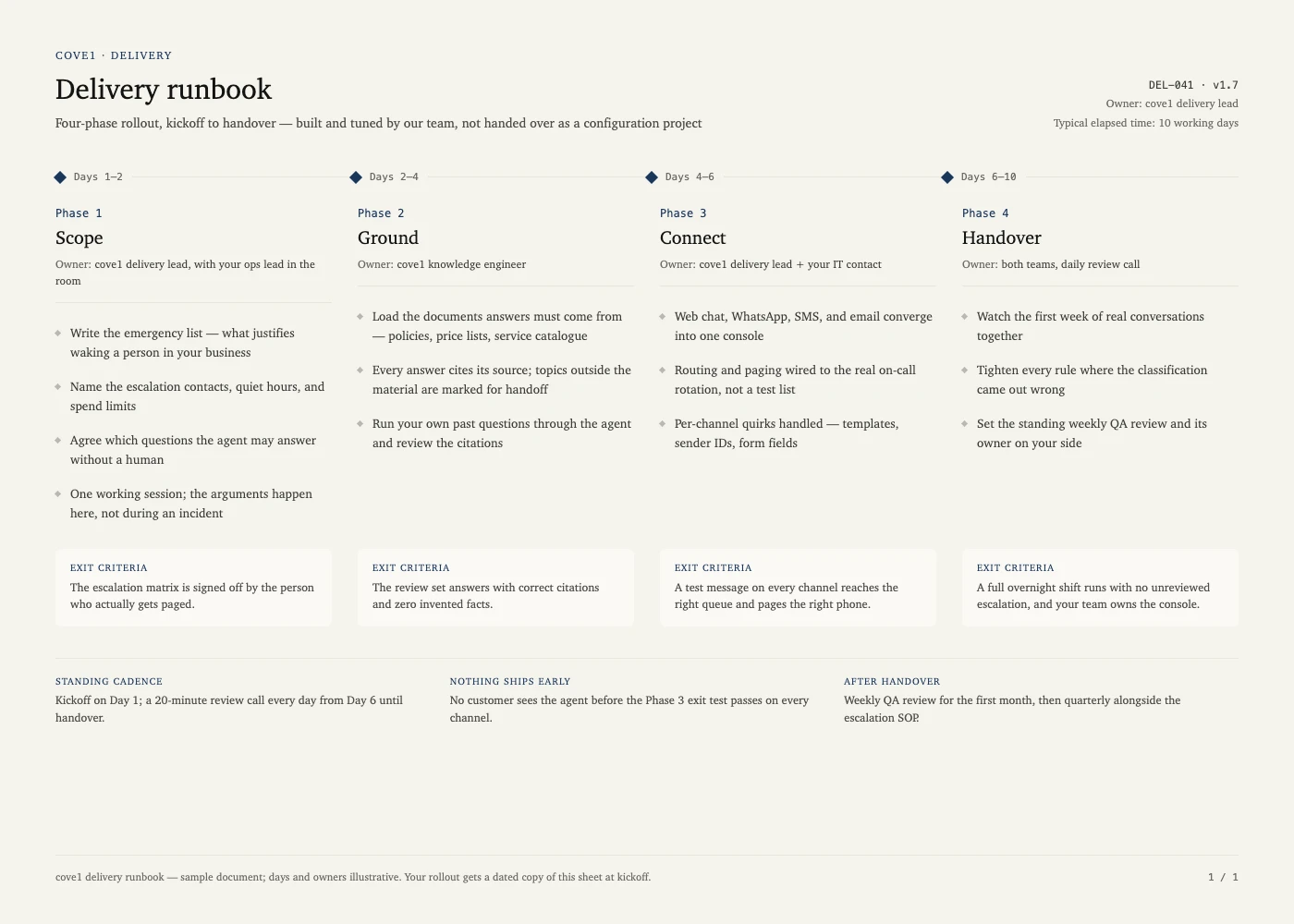
- We build it, which is why most firms cover their first weekend within days rather than running a configuration project for a quarter. Setup is one working session: we connect your channels, load the practice pages, fee information and FAQ that answers should come from, transcribe your intake questionnaire per practice area, and write down the escalation rules — who the duty attorney is, what reaches them immediately, what always goes to a human. Then we review the first week of real conversations and tighten every classification that came out wrong.
Stop losing weekend intakes to an unread inbox
We build and tune your legal intake coverage for you. Book a demo and watch cove1 run an intake, route a client question, and refuse to give legal advice — in one session.
Prefer to read first? See the product, our after-hours answering service, our property management answering service, our HOA answering service, or how cove1 compares to Smith.ai.