HVAC
For HVAC contractors, service managers, and dispatchersHVAC Answering Service for Heating and Cooling Contractors
cove1 is an HVAC answering service for the messages your team cannot get to — the 9 p.m. no-heat text, the Saturday no-cool request, the website form sitting unread until Monday. It triages against your own rules, escalates real emergencies to your on-call rotation, and turns the rest into work orders.
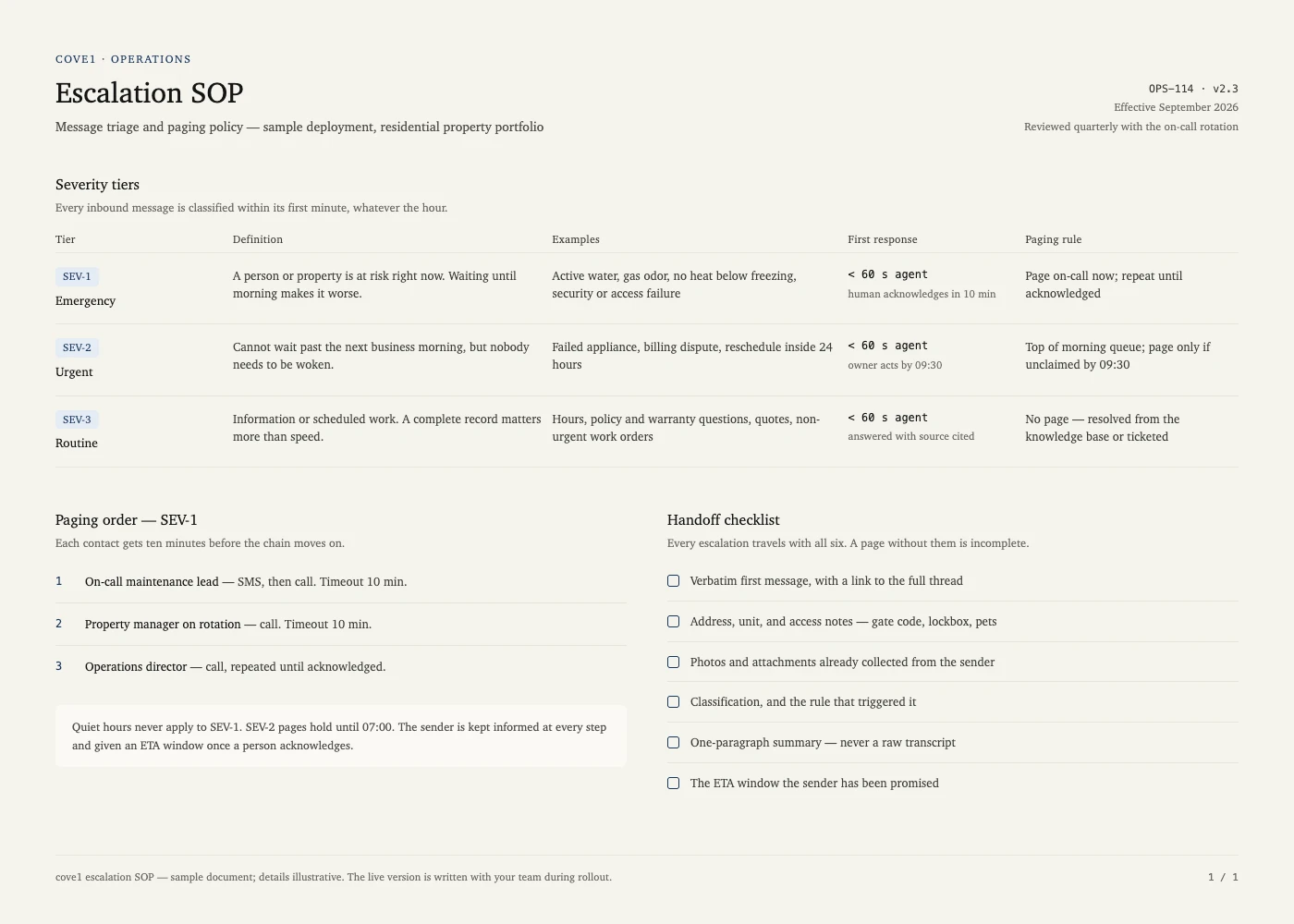
Three-tier triage built for HVAC dispatch
Any answering service for HVAC lives or dies on one judgment: truck roll tonight, or a slot on tomorrow’s board? cove1 sorts every message the way your best dispatcher would — using your definition of an emergency, your rotation, and your service area — so nobody reads forty overnight texts at 6 a.m. hunting for the two that mattered.
That judgment gets costly on the days it is hardest to make. The first hard freeze and the first heat advisory multiply inbound volume while every tech is already booked and your dispatcher is on the radio. A missed no-heat message that night is not one lost repair ticket: equipment that quits on the coldest night is usually old equipment, and a homeowner in a cold house at 9 p.m. is the most motivated replacement conversation you will have all winter. Miss it and the contractor who answers gets the whole system.
No heat, no cool, or a safety trigger — escalated tonight
No heat with the overnight low at or below freezing. No cooling under a heat advisory. Vulnerable occupants in the house. cove1 spots these in the first message and pages whoever is genuinely on your rotation. Gas odor and CO alarms are handled differently on purpose: they fire your pre-approved script — leave the building, then call the gas utility or 911 from outside — verbatim. No model reasons about safety.
Refrigerant, noise, drips, thermostats — into the morning queue
Low charge and suspected leaks, a grinding condenser, water at the air handler, a dead thermostat, weak airflow. Each becomes a work order carrying make, model, serial, the fault code on the display, system age, address, gate code or lockbox, dogs, attic access, and plan status — and lands on tomorrow’s board already sorted.
Hours, service area, plans, pricing — answered with a source
Do you cover my ZIP code. What does the maintenance agreement include. Is the diagnostic fee credited toward the repair. Do you finance. These are answered from your own documents with the source cited, so Monday is not spent retyping the same four replies.
Every text and form fill in one place
Web chat, SMS to your published business number, WhatsApp, email, and your request-service form land in one console. Homeowners who would never sit through a phone tree will text at 9 p.m.; property managers who email get the same triage.
Grounded in your service area, plans, and price book
An HVAC answering service is only as good as its sources. Answers come from your documents — ZIP codes covered, plan inclusions, the diagnostic fee, financing, warranty terms — each citing where it came from. When a question needs a tech’s eyes or a real quote, cove1 routes it rather than inventing one.
Aware of your on-call rotation, not a generic script
Your rotation, branches, brands, after-hours rate, and spend thresholds live in the system. Sunday’s escalation reaches whoever is on call this week, and the customer sees the rate in writing before a truck rolls — not on the doorstep at 10 p.m.
A person owns anything the agent should not
Commercial accounts, warranty disputes, anything priced above your threshold, and anything the agent is unsure about goes to your team with the thread attached. cove1 never negotiates a quote or makes a safety call. AI triages; your people stay accountable.
A Sunday-night no-heat text, end to end
Names and timestamps are illustrative; the sequence is the one cove1 runs. Nothing in it waits on someone being awake.
- Sunday, 9:02 p.m. — the text arrives
“no heat, 2 kids at home” hits your business number. cove1 replies in seconds with the three questions your dispatcher would ask: is anyone unwell, do you smell gas or hear a CO alarm, and what is the address.
- 9:03 p.m. — classified against your rules
No gas odor, house at 54 degrees, two young children. That clears your tier-one bar, so cove1 pulls the account: existing customer, fourteen-year-old furnace, agreement lapsed in March.
- 9:04 p.m. — the on-call tech is paged, once
Whoever is on rotation gets the address, access notes, system details, the customer’s own words, and confirmation the after-hours rate was accepted. No callback needed before getting dressed.
- 9:06 p.m. — the customer stops guessing
cove1 confirms the arrival window and passes on your approved cold-weather guidance, so nobody sits refreshing a chat window or calls your competitor to hedge.
- Monday, 7:10 a.m. — the follow-up exists
The thread, the triage decision, and a flag reading “fourteen-year-old system, agreement lapsed” sit in your morning queue as a replacement-quote follow-up, not in a tech’s personal phone.
Where an HVAC answering service is the wrong tool
cove1 is message-based, and in HVAC that boundary matters more than in most trades: your long-standing residential customers, the ones holding maintenance agreements, still call. A homeowner with no heat and a phone in hand dials before they think to text. cove1 covers the SMS, web chat, WhatsApp, email, and website-form side of that demand; it does not answer a ringing line. If your after-hours plan today is a live call center, we sit beside it — voice stays there, cove1 absorbs the texts and form fills that center never sees, and both land as one record. If you need a voice receptionist, say so on the demo; we would rather tell you no than sell half a solution.
Two more cases where we would talk you out of it. A one-truck shop whose owner already answers every message inside ten minutes is not losing revenue to response time. And commercial mechanical bid work is not a triage problem. In both, an HVAC answering service is the wrong line item.
HVAC answering service FAQ
- Is this a phone answering service for HVAC companies?
- Not in the traditional sense, and we would rather be blunt. cove1 is message-based: SMS to your business number, web chat, WhatsApp, email, and your website’s request-service form. It is not an HVAC phone answering service that picks up a ringing line. Plenty of HVAC customers still call, especially long-standing residential accounts, so most contractors run cove1 alongside whatever handles voice — a dispatcher by day, a call center after hours. Either way the result lands as one work order. If you need pure voice coverage, say so on the demo and we will tell you whether we fit.
- How does an HVAC after hours answering service decide what is a real emergency?
- You write the rules; cove1 applies them the same way at 2 a.m. as at 2 p.m. Most contractors define tier one as no heat when the overnight low is at or below freezing, no cooling during a heat advisory, any suspected gas odor or CO alarm, water actively damaging property, or a household with vulnerable occupants. cove1 asks the qualifying questions your dispatcher would ask, checks them against your definition and service area, then pages the on-call tech. Everything below that bar is captured and scheduled. Most shops retune the rules between heating and cooling season.
- What happens if a customer reports a gas smell or a CO alarm?
- Safety is not something we let a model reason about. Those two triggers fire a fixed, pre-approved response the instant they appear: leave the building, do not switch anything electrical on or off, and call your gas utility’s emergency line or 911 from outside. The wording is yours, reviewed before launch, and it goes out verbatim — no paraphrasing, no clarifying questions first. In the same second cove1 pages your on-call contact, so a person knows a possible gas or CO event is live. cove1 will never suggest a smell is probably nothing.
- We run two branches and three brands. Can an HVAC call answering service handle that?
- Yes, and it is the normal configuration rather than an upgrade tier. Each brand or branch gets its own knowledge base, ZIP code list, after-hours rate, on-call rotation, and escalation contacts. A message arriving on the residential brand’s number is triaged with that brand’s rules and reaches that brand’s dispatcher; the commercial side keeps its own. Out-of-area requests are recognized and answered with your referral policy instead of being booked and cancelled next morning. Acquiring a shop mid-season is a configuration change, not a rebuild.
- How fast can we get an HVAC answering service live before the season turns?
- Days rather than months, because we configure it for you instead of handing you a builder. The work is connecting your channels, loading your service area, plans, and price book, then writing the triage rules and on-call rotation with your dispatcher in the room. The honest constraint sits on your side: the rules only get good if someone who actually dispatches gives us an hour. Contractors who start in September are tuned before the first hard freeze. Starting the week of a cold snap works, but you will be adjusting live.
Stop losing no-heat texts to whoever answers first
We configure and deliver the HVAC answering service for your shop — your service area, your rotation, your rules. Book a demo and watch it triage a no-heat text against your own escalation rules.
This page is scoped to heating and cooling work — no-heat, no-cool, refrigerant, thermostats, gas and CO reports. If the call is water rather than air, our plumbing answering service runs a different emergency list (active water, sewage, no water at all) and a different set of intake questions.
Prefer to read first? See how cove1 handles after-hours answering across every trade, our property management answering service, our plumbing answering service, our bilingual answering service, or the product itself.