Plumbing
For plumbing contractors, dispatchers, and drain shopsPlumbing Answering Service for Residential and Commercial Plumbers
cove1 is a plumbing answering service for the messages your team cannot get to — the 11 p.m. flooding text, the Sunday sewage backup, the website form sitting unread until Monday. It triages against your own rules, escalates the real emergencies to your on-call rotation, and turns the rest into work orders.
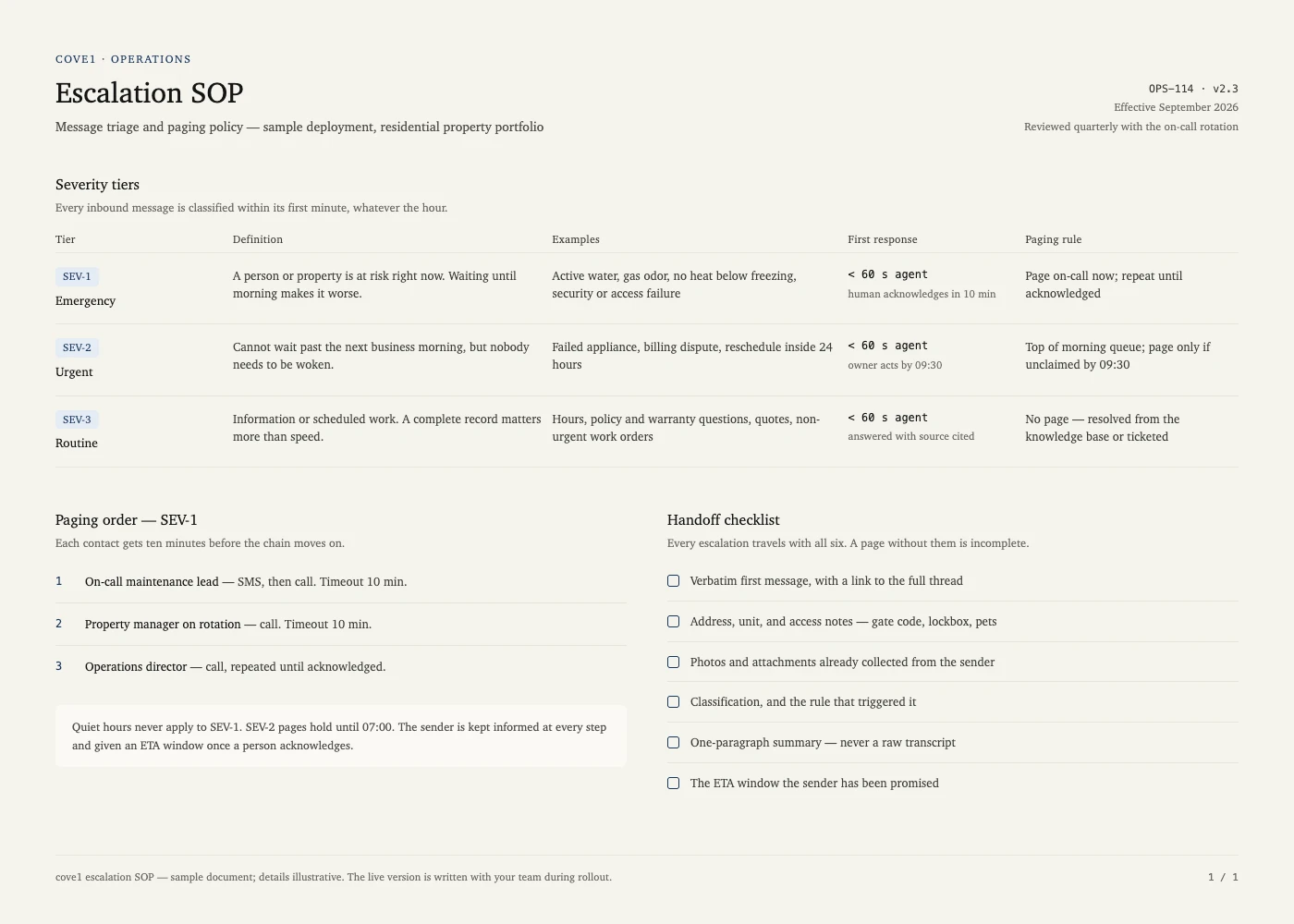
Three-tier triage built for plumbing dispatch
Every answering service for plumbers lives or dies on one judgment: does this get a truck tonight, or a slot on tomorrow’s board? cove1 sorts each message the way your best dispatcher would — using your definition of an emergency, your rotation, and your service-area boundaries — so nobody scrolls forty overnight texts at 6 a.m. hunting for the two that actually mattered.
Plumbing punishes a slow response harder than most trades, and the reason is structural. A burst pipe is instant demand: the customer is standing in water, so they contact three shops at once and whoever answers first books the job. The overnight window is also not a random sample of your work — routine unclogs get sent during business hours, while emergencies self-select into the night.

Active water, sewage, or no water at all — escalated tonight
A burst supply line, water crossing a finished floor, sewage coming up through a floor drain, a property with no water at all. cove1 catches these in the first message, walks the customer to their main shutoff if they can reach it safely, and pages whoever is genuinely on your rotation. Suspected gas around a water heater and any CO alarm are handled differently on purpose: they fire your pre-approved script — leave the building, then call the gas utility or 911 from outside — word for word. No model reasons about a safety call.
Drips, slow drains, cold showers — into the morning queue
A dripping faucet, a shower draining slowly for two weeks, a water heater producing lukewarm water, a toilet that runs all night. Each becomes a work order carrying the address and unit, gate code or lockbox, where the shutoff and water meter are, how long the problem has been happening, whether it is getting worse, water heater age and fuel type, dogs on site, and who lets the tech in — sorted onto tomorrow’s board before anyone opens a laptop.
Service area, fees, hours, surcharges — answered with a source
Do you cover my ZIP code. Is the trip charge credited against the repair. What counts as after-hours and what does the emergency rate add. Do you quote over text or does someone have to come out. Are you licensed for gas work in this county. These come back from your own documents with the source cited, so Monday morning is not spent retyping the same five answers.
Every text and form fill in one console
Web chat, SMS to your published business number, WhatsApp, email, and your website’s request-service form land in one place. Homeowners photograph the puddle and text it at 11 p.m.; property managers email a list of three units. Both get the same triage and arrive as the same kind of record.
Grounded in your service area and price book
A plumbing answering service is only as good as what it is allowed to say. Answers come from your documents — ZIP codes you cover, trip and diagnostic fees, after-hours rates, what you will and will not touch — each citing its source. When a job needs a real quote or a tech’s eyes, cove1 routes it instead of guessing at a number you will have to walk back.
Aware of your on-call rotation, not a generic script
Your rotation, trucks, service-area boundaries, after-hours rate, and spend thresholds live in the system. A Saturday escalation reaches whoever is actually on call that weekend, and the customer sees the emergency rate in writing before a truck rolls — not on the doorstep at midnight with a wet floor as leverage.
A person owns anything the agent should not
Insurance and water-damage claims, commercial accounts, repipe and sewer-line jobs above your threshold, and anything the agent is unsure about go to your team with the thread attached. cove1 never negotiates a price and never makes a safety call. It triages; your people stay accountable.
A Friday-night flooding text, end to end
Timestamps are illustrative; the sequence is the one cove1 runs. Nothing in it waits on someone being awake.
- Friday, 11:04 p.m. — the text arrives
“basement flooding, water everywhere” hits your business number. Nobody on your team is awake. cove1 replies inside a minute with the questions your dispatcher would ask: is the water still running, can you reach the main shutoff, is it clean water or sewage, and what is the address.
- 11:05 p.m. — safety and shutoff first
The water is still coming. cove1 gives your approved shutoff guidance — where the main valve usually sits on a house of that type, which way to turn it, and to stay clear of standing water near outlets or the panel. If a gas smell or CO alarm had been reported instead, the evacuate-and-call-911 script would have fired verbatim and skipped everything else.
- 11:07 p.m. — classified against your rules
Active water inside a finished space clears your tier-one bar. cove1 pulls the account: existing customer, ZIP inside your service area, no open jobs. The after-hours rate is quoted in writing and accepted in the thread.
- 11:08 p.m. — the on-call tech is paged, once
Whoever is on this weekend’s rotation gets the address, the photo, the shutoff status, gate code, dog note, and the customer’s own words in one message. Nothing to call back and clarify before getting dressed.
- Saturday, 7:30 a.m. — everything else exists too
The four other overnight messages — a running toilet, a water heater quote request, a slow kitchen drain, and someone outside your service area — are already sorted: three work orders with addresses and access notes, one referral answered from your policy. The flood job’s audit trail, rate acceptance included, sits with the ticket.
Where a plumbing answering service is the wrong tool
cove1 is message-based — web chat, WhatsApp, SMS, email, and your website form — and in this trade that boundary deserves to be stated up front rather than buried. Almost every incumbent plumbing answering service is a live-agent phone operation: as of 2026-09, AnswerConnect, Smith.ai, PATLive, AnswerForce, and Nexa all publicly position themselves around real people picking up your line. We do not do that, and we are not going to pretend otherwise in a demo. If a ringing, unanswered phone is the problem you are trying to solve, hire one of them.
The reason we still belong on this page is that for a lot of shops the phone is no longer the leak. What drains a plumbing business at night is the pile of messages nobody is triaging: texts to the number on the truck, the website form, the WhatsApp thread a property manager started last week. A call center never sees any of it. Most shops run both — voice stays where voice is handled, cove1 absorbs the message channels, and both land as one work order.
Two more cases where we would talk you out of it. A one-truck owner who already answers every text inside ten minutes is not losing revenue to response time; adding a layer only slows the conversation down. And commercial bid work — a spec package, a multi-building repipe — is an estimating problem, not a triage problem. In both, this is the wrong line item.
Plumbing answering service FAQ
- Is this a phone answering service for plumbers?
- No, and it is worth knowing before you book a demo. cove1 is message-based: SMS to your business number, web chat, WhatsApp, email, and your website’s request-service form. It does not pick up a ringing line. As of 2026-09, the established plumbing answering services — AnswerConnect, Smith.ai, PATLive, AnswerForce, Nexa — are publicly built around live agents taking calls, so if a ringing phone is your actual problem, one of them fits better than we do. Many shops run both: a call answering company on the voice line, cove1 on the message channels nobody watches overnight. If you need voice, raise it on the demo and we will scope it honestly rather than sell half a solution.
- How does a plumbing answering service decide what is a real emergency?
- You write the rules; cove1 applies them the same way at 2 a.m. as at 2 p.m. Most shops define tier one as water actively escaping and damaging property, a sewage backup, a property with no water at all, a failed water heater leaking onto a finished floor, or any suspected gas odor near a gas heater. cove1 asks the qualifying questions your dispatcher would ask, checks the answers against your definition and your service area, then pages the on-call tech. Everything below that bar is captured as a scheduled work order instead. The rules are yours to retune — most shops tighten them after a hard freeze week teaches them what actually justified a truck.
- What happens if someone reports a gas smell or a carbon monoxide alarm?
- Safety is not something we let a model reason about. Those triggers fire a fixed, pre-approved response the instant they appear: leave the building, do not switch anything electrical on or off, and call your gas utility’s emergency line or 911 from outside. The wording is yours, reviewed before launch, and it goes out verbatim — no paraphrasing, no clarifying questions first, no attempt to assess whether the smell is serious. In the same second cove1 pages your on-call contact so a person knows a possible gas or CO event is live. cove1 will never tell a customer a gas smell is probably nothing, and it will never troubleshoot a water heater over text when gas has been mentioned.
- Why does a missed overnight message cost more in plumbing than in other trades?
- Because a burst pipe is instant demand, not considered demand. Someone standing in water does not wait for a callback — they work down the search results and call three shops, and the first one to respond gets the job. The mechanism is what makes the exposure asymmetric: the message you miss at midnight is rarely a routine unclog, because routine problems get sent during business hours. Emergencies self-select into the overnight window. A single missed after-hours text can be a repipe, a sewer line, or a water heater replacement plus the insurance-adjacent work that follows it — and that customer, once someone else has been in their basement, is now someone else’s customer.
- We run two trucks and cover three counties. Can it handle service-area rules?
- Yes, and it is the normal configuration rather than an upgrade tier. Your ZIP code list, per-county licensing constraints, after-hours rate, on-call rotation, and escalation contacts all live in the system. A request from outside your area is recognized and answered with your referral policy instead of being booked and cancelled the next morning — which is where a lot of small shops quietly lose a slot per week. If you run separate residential and commercial identities, each gets its own knowledge base and its own escalation path, so a commercial backup does not page the residential rotation.
- How long does it take to go live, and what do we have to do?
- Days rather than months, because we configure it for you instead of handing you a builder. The work is connecting your channels, loading your service area, fee schedule, and after-hours rates, then writing the triage and escalation rules with someone from your side in the room. The honest constraint sits with you: the rules only get good if a person who actually dispatches gives us an hour to define what deserves a truck tonight. Shops that skip that hour end up with a polite agent that escalates everything, which is the same as escalating nothing. After launch we tune against real conversations for the first couple of weeks.
Stop losing flooding texts to whoever answers first
We configure and deliver the plumbing answering service for your shop — your service area, your rotation, your rules. Book a demo and watch it triage a real overnight flooding text against your own escalation logic.
This page is scoped to plumbing work — active water, sewage backups, no water, drips and slow drains. If the message is about heating or cooling instead, our HVAC answering service runs a seasonal emergency list and captures model and fault codes rather than shutoff locations.
Prefer to read first? See our HVAC answering service, how cove1 handles after-hours answering across every trade, our property management answering service, or the product itself.