Bilingual
For teams whose customers do not all write in EnglishBilingual Answering Service for Spanish and English Messages
cove1 reads every inbound message in the language it arrives in, answers in that same language from one shared knowledge base, and hands anything it should not answer to your team with the original and a translation side by side.
For everyone else, a bilingual answering service is a rota problem
Ask any provider in this category how they cover Spanish and the answer is a schedule. Someone bilingual sits a shift. Your Spanish coverage is therefore whatever hours you can hire and pay for, which in practice means weekday business hours, sometimes an upgraded tier, and a gap everywhere else. At 3 a.m. a Spanish message does not get slower service because the system is worse in Spanish. It gets slower service because nobody who reads Spanish is awake.
That constraint does not exist here. There is no Spanish rota to fill, so there is no hour of the week where the second language is cheaper to drop. A Spanish message at 03:12 and an English message at 10:04 hit the same triage tree, the same emergency thresholds, and the same escalation contacts. The only thing that changes is which language the reply comes back in.
The claim is deliberately narrow. We are not saying our Spanish beats a bilingual person’s Spanish; we are saying it is the same Spanish at hours you were never going to staff, on channels no receptionist was watching.

Three things a bilingual answering service has to get right
Detecting the language without asking, answering from one set of facts rather than two translated copies, and getting the thread to a colleague who may not read that language at all.
The message decides the language, not a menu
There is no “press 2 for Spanish” and no separate Spanish inbox to route into. cove1 reads the first inbound message, identifies the language, and replies in it. If the sender switches mid-thread — which people comfortable in both languages do constantly — the replies follow them, and it stays one thread with one triage state.
One set of facts, answered in every language
You do not maintain a Spanish copy of your policies next to the English one. Answers are generated from a single source of truth in the sender’s language, so when your cancellation window changes on Tuesday it changes in every language on Tuesday. Parallel translated content is where version drift starts: the English page says 30 days, the Spanish page still says 14, and nobody notices for a year.
Escalations arrive as original plus translation
When a thread goes to a person, your team gets the sender’s exact words, an English rendering of them, and the structured summary. A dispatcher who speaks no Spanish can read what happened, act, and reply in English — and cove1 sends that reply back in the sender’s language. Handoff is normally where bilingual coverage falls over; here it is a translation step, not a staffing one.
Every text channel, in either language
Web chat, WhatsApp, SMS, email, and website forms land in one console. WhatsApp matters especially here: for a lot of teams it is where Spanish-language conversations actually happen, and it is the channel no receptionist is watching.
Your terminology, not a dictionary’s
You supply the terms that must not be loosely translated — unit and plan names, brand names, trade vocabulary, defined legal terms — and they stay locked in both languages. Generic machine translation is where bilingual answering services quietly go wrong; a controlled glossary is the fix.
Escalation rules that also watch the translation
Anything phrased as a legal, medical, or financial commitment goes to a human in every language, including English. Low confidence in the translation itself is an escalation trigger in its own right, ranked alongside low confidence in the answer.
Tuned and evaluated per language pair
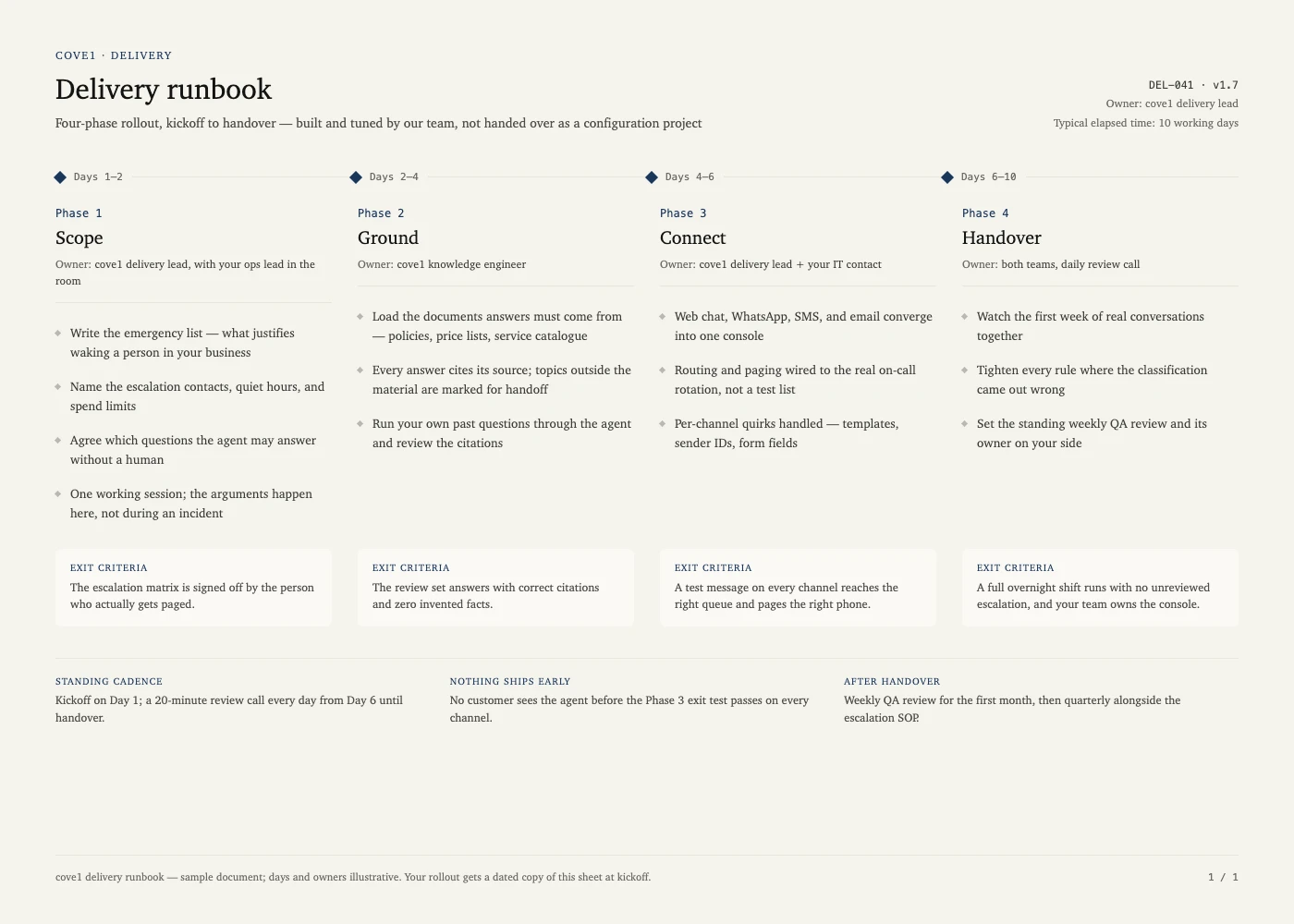
We do the build: connect the channels, load your documents, write the glossary and the escalation rules, then evaluate against your own past conversations in each language. Every language we tune is named in writing, and anything not on that list is described as untested.
One Spanish maintenance request, start to finish
The shape of a configured deployment for a property team with a monolingual on-call rotation. Times are illustrative; the sequence is the one the agent follows.
- 03:12
A Spanish message arrives on WhatsApp
“El agua no para en el baño del 4B.” cove1 identifies the language from that first line and answers in Spanish inside a minute. Nobody on your team is awake, and no Spanish-speaking shift exists at this hour.
- 03:12
It runs the same triage tree as an English message
Active water is on your tier-one emergency list. The language changed the wording of the reply; it did not change the rules, the thresholds, or who gets paged. That is the point of one knowledge base instead of two.
- 03:13
Follow-up questions, asked in Spanish
Is the water still running, is it clean or waste water, can maintenance enter the unit tonight. The agent asks what your dispatcher would ask, in the sender’s language, and a photo comes back.
- 03:15
Escalation to an on-call lead who speaks no Spanish
He receives an English summary, the original Spanish verbatim underneath it, the photo, and the access note. He replies “on my way, about 25 minutes” in English; the tenant receives it in Spanish.
- 08:00
Handover, with both languages on the record
Your morning queue holds one closed emergency with a bilingual audit trail. Any term flagged as low-confidence — a regional word for a fixture, say — is listed for review and added to the locked glossary so it is right next time.
Where machine translation breaks, and what we do about it
Translation is weakest exactly where language is most local. Regional vocabulary, slang, idiom, and trade jargon are the reliable failure cases: a fixture has one name in Mexico City and another in San Juan, and a fluent-sounding wrong word is harder to catch than an obvious one. Without a glossary this happens more often, not less, which is why locked terminology is part of the build rather than an option.
We do not claim native-level fluency, and we would not believe a vendor who did. Anything phrased as a legal, medical, or financial commitment — a notice, a diagnosis, a payoff figure, a coverage decision — is routed to a person in every language, English included. That is a hard rule, not a fallback: if a badly worded Spanish sentence would create liability, an AI should not be writing it, and regulated notices need a qualified human translator regardless of who answers your messages.
Scope is written down, not implied. The languages we have tuned and evaluated against your own past conversations are listed for your deployment; anything not on that list is untested for your content and we say so rather than quote a language count. And a bilingual human still beats us with an upset customer working in their second language — there the measure of success is how fast the thread reaches a person, not how long the agent keeps trying.
cove1 is not a bilingual phone answering service
Nearly every established name in this category is a live-agent call service. AnswerConnect, AnswerForce, Nexa, ReceptionHQ, and Abby Connect all publicly staff human receptionists on phone calls and market bilingual English and Spanish coverage (checked 2026-09). If a ringing line in Spanish is the thing hurting you, buy from one of them — we would rather say that here than on a sales call.
cove1 works the message channels: web chat, WhatsApp, SMS, email, and website forms. No voice, no receptionist picking up. That is a deliberate position, because for most teams we talk to the thing that breaks is not an unanswered ring — it is the Spanish WhatsApp message that sat unread for eleven hours because the person who reads Spanish works Tuesdays and Thursdays. Bilingual voice cover does nothing for that queue.
Running both is sensible: a live bilingual receptionist on the phone line, cove1 on the text channels overnight and at peak. If you need voice in the same project, say so at the demo and we will scope it with you rather than pretend the coverage is there.
Bilingual answering service FAQ
- What does a bilingual answering service actually do, and how is this one different?
- A bilingual answering service handles inbound customer contact in more than one language, so a Spanish-speaking customer gets the same response quality and response time as an English-speaking one. Most providers deliver that by scheduling bilingual human agents, which bounds your Spanish coverage by how many bilingual shifts you can staff and afford. cove1 covers the message channels instead — web chat, WhatsApp, SMS, email, and website forms — so language stops being a scheduling variable. The same triage logic, knowledge base, and escalation rules apply to a 3 a.m. Spanish message and a 10 a.m. English one. What differs is the language of the reply, not who is on shift.
- Is this a Spanish answering service, or does it cover other languages?
- Spanish and English is the pair this page is written around, because it is the pair we are asked about most often in the US, and a Spanish speaking answering service is what most buyers in this category are actually shopping for. The underlying system is not limited to two languages, but we would rather be specific than advertise a language count. For each deployment we name in writing the languages we have tuned and evaluated against your own past conversations, including the glossary and the escalation rules for each. A language that is not on that list is untested for your content, and we will say so rather than let a big number imply coverage we have not verified.
- Can cove1 work as a bilingual virtual receptionist on our phone line?
- No. cove1 is message-based and does not answer calls, so if you are searching for a bilingual virtual receptionist to pick up a ringing line in Spanish, we are not the product. Providers in this category such as AnswerConnect, AnswerForce, Nexa, ReceptionHQ, and Abby Connect publicly staff live receptionists on phone calls and market bilingual English and Spanish coverage (checked 2026-09). Buy voice from one of them. Plenty of teams run both: a live bilingual receptionist on the phone line, cove1 on the text channels that nobody is watching after hours. If voice matters to you as well, raise it at the demo and we will scope it honestly instead of implying we cover it.
- How accurate is it in Spanish, and what happens when it gets a term wrong?
- Accurate enough for routine service conversations, and not good enough to be trusted unsupervised on anything consequential — which is why the escalation rules exist. The predictable failures are regional: slang, idiom, and trade vocabulary that differ between countries, where the word for a plumbing part in Mexico City is not the word used in San Juan. Two things reduce this. First, a locked glossary you control, so your terms are never paraphrased. Second, low translation confidence is treated as an escalation signal, so a doubtful thread goes to a person rather than continuing in fluent-sounding but wrong Spanish. Flagged terms are reviewed after the fact and folded back into the glossary.
- Do we have to maintain a separate Spanish version of our knowledge base?
- No, and we would advise against it. Maintaining parallel translated content sets is the most common way bilingual support goes stale: the English source gets updated, the Spanish copy does not, and for months the two languages quote different refund windows or different fees. cove1 answers from one source of truth and produces the reply in the sender’s language at the moment of the reply, so an edit propagates everywhere at once. The exception is deliberate: if a policy genuinely differs by market or jurisdiction, that belongs in the knowledge base as two distinct facts with the conditions attached — not as a translation.
- Nobody on our team speaks Spanish. What does a handoff look like for us?
- That case is the reason the handoff format exists. An escalated thread reaches your team as three things stacked together: a structured English summary of what was requested and what has been established, the sender’s original messages verbatim, and an English rendering of those messages so you can check the summary against its source. Your team replies in English and cove1 delivers it in the sender’s language. Nothing in the escalation needs a bilingual person on your side, which is what makes round-the-clock Spanish coverage workable for a monolingual team. For legally or medically sensitive wording, use a qualified human translator — that boundary is described above.
Give Spanish the same hours as English
We build and tune your bilingual coverage for you, glossary included. Book a demo and watch cove1 triage a Spanish emergency and hand it to an English-speaking on-call lead in the same session.
Prefer to read first? See the product, our after-hours answering service, our property management answering service, or our HOA answering service.