Knowledge Base Software for AI Support Agents
See what separates a knowledge base an AI support agent can cite from a document dump it hallucinates over — chunking, scope, freshness, and a 12-point audit.

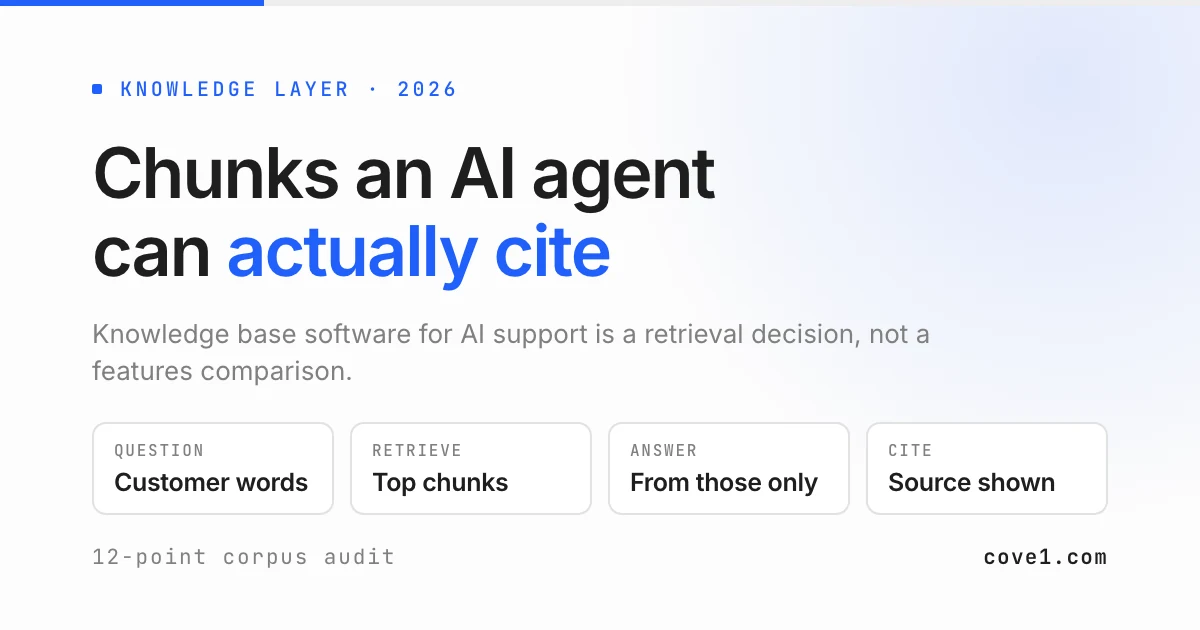
TL;DR: choosing knowledge base software for AI support is not a features comparison, it is a retrieval decision. An AI agent does not read your help center the way a customer does — it reads whatever chunk the retriever hands it, and nothing else. So the question that decides answer quality is not "does this tool have categories and a search bar," it is "when a customer asks this in their own words, does the passage containing the answer come back, and can the agent cite it?" Everything below is about structuring for that.
Most knowledge base software was designed when the reader was a human with a mouse. A person scans headings, opens the article that looks closest, and reconstructs the answer from context — including context three paragraphs above the sentence they needed. Humans are extraordinarily good at that reconstruction, which is why a badly organised help center still mostly works.
An AI support agent has none of that tolerance. It sees a handful of passages a retriever selected, and answers from those. If the relevant sentence arrives without the qualifier that makes it true, the agent confidently states something false. If the passage was not retrieved at all, a well-configured agent declines and hands off, and a badly configured one invents. Both trace back to the same place: how the material was written, split, and scoped.
This post is about that. It is the strategy layer. If you want the mechanics of importing documents, inspecting which chunks an answer used, and scoping datasets in cove1 specifically, our knowledge base documentation is the how-to; this page is the why and the structural rules that apply whichever tool you use.
What "knowledge base software for AI support" actually has to do
Strip away the marketing and there are five jobs. A traditional help-center product does the first two well and ignores the rest. A knowledge layer built for AI has to do all five.
| Job | Human-first help center | What an AI agent needs |
|---|---|---|
| Store and publish | Articles, categories, a public site | Same, plus programmatic access to raw text |
| Search | Keyword search a person refines by hand | Semantic retrieval on one shot, no refinement |
| Split | Not applicable — humans read whole pages | Chunks that stand alone out of context |
| Scope | One search index for everything | Per-agent datasets, so a billing bot never retrieves shipping policy |
| Attribute | A URL the reader can see | A citation the agent returns and your team can audit |
The middle rows are where most migrations fail. Teams port a well-loved help center into an AI tool, get poor answers, and conclude the model is weak. Usually the model is fine and the chunks are wrong.
The retrieval chain, and the five places it breaks
Every grounded answer runs the same path: question, query, retrieve, assemble, answer. Each step fails on its own, and the failures look identical to the customer — a wrong or evasive reply — which is why "the AI is bad" is such an unhelpful diagnosis.
1. The question is not in your vocabulary. A customer writes "how do I get my money back." Your article is titled "Refund policy" and never uses the word money. Semantic retrieval handles most of this gap, which is exactly why it is worth having, but it does not handle jargon you invented. If your product calls a subscription a "seat allocation" and nothing in the corpus connects that phrase to "plan," retrieval will miss.
2. The right chunk exists but does not win. Three documents mention refunds: a 2023 policy, a superseded promotional exception, and the current rule. All three sit close to the query. The retriever returns whatever scores highest, frequently the stale one, because stale documents are often longer and more explicit.
3. The chunk was split badly. This is the most common and the least visible failure. A 4,000-word policy page split on a fixed character count produces chunks that begin mid-sentence and end mid-condition. The passage that says "refunds are issued within 14 days" gets separated from the sentence that says "this applies only to annual plans." The agent retrieves the first and states it as universal. Nothing about that output looks like a retrieval bug; it looks like the AI lying.
4. Too much came back. Some teams respond to misses by widening retrieval — twelve chunks instead of four. Now the model must pick the right claim out of a pile containing two contradicting ones, and it will sometimes blend them into a sentence that appears in none of your documents.
5. Nothing relevant came back and the agent answered anyway. A configuration failure rather than a content one, and the only item here that is fixable in an afternoon: instruct the agent to decline or escalate when retrieval returns nothing above the relevance floor. An honest "let me get someone who can confirm that" costs you a handoff. A confident wrong answer costs you the customer's trust in every future answer.
Structure that makes an AI agent answer correctly
The rules below are boring and they are the entire game.
Write self-contained sections. Every heading-and-body unit should make sense to someone who has read nothing else on the page. Practically: repeat the qualifier. If refunds differ by plan, say "annual plans" inside the annual paragraph rather than relying on the H2 four screens up. Redundancy that would irritate a human reader is what keeps a retrieved chunk true.
Split on meaning, not on length. Prefer chunking that respects headings and paragraph boundaries. A 90-word section that answers one question completely retrieves better than a 400-word section that answers four questions partially, because the shorter one has a tighter semantic centre.
Put the answer in the first sentence. Retrieval scores the passage; the model reads it. Both do better when the claim is stated up front and the reasoning follows, rather than the reverse.
One canonical document per rule. If the shipping cut-off time appears in four places, three of them will eventually go stale, and the retriever has no way to know which is current. Consolidate, then link. This single habit removes more wrong answers than any model upgrade.
Say the customer's words at least once. Include the phrasing people actually use — refund, cancel, money back, charged twice — somewhere in the section, even if your internal vocabulary differs. You are not keyword-stuffing for a search engine; you are giving the retriever a bridge.
Scope datasets per agent. A billing agent attached only to billing material retrieves cleaner context than one pointed at the entire corpus. Narrow scope is a quality lever, not a limitation. This is also the cheapest fix available to most teams: no rewriting, just attaching less.
Date and own every document. A last-reviewed date and a named owner on every article. Not for the customer — for the quarterly pass where you find the documents nobody has touched since a policy changed.
Structure that makes an AI agent hallucinate
The inverse list, from the material we most often find when a rollout is answering badly:
- Wall-of-text pages. A 6,000-word "everything about billing" page is one document to a human and forty ambiguous fragments to a retriever.
- Tables that carry meaning in the header row. Split a table and the rows arrive without their column labels. If a table encodes a rule, restate the rule in prose beneath it.
- Screenshot-only instructions. If the steps live in an image, they are not in the corpus. Whatever the agent says about that flow, it invented.
- Near-duplicate documents. The 2024 policy, the 2025 policy, and the draft. Retrieval has no opinion about which one you meant.
- Internal caveats mixed into customer-facing text. "Do not tell customers this, but we sometimes waive the fee" will eventually be told to a customer.
- Answers that live only in past tickets. A raw ticket archive imports the wrong answers your team gave two years ago, alongside personal data you did not intend to index.
What we build on, and why we are saying so
cove1's knowledge layer is built on FastGPT. We publish that in our documentation and we repeat it here because it is directly relevant to how you should evaluate this category: the retrieval behaviour described above is not something we invented, and any tool built on a similar retrieve-then-reason pattern will show the same failure modes. What we deliver on top is the part that is actually hard — importing and re-splitting your material so chunks stand alone, scoping datasets per agent, wiring the decline-and-escalate gate, and then correcting the corpus against real conversations for the first few weeks.
That is also our bias, stated once: we sell a delivered rollout, so we think the corpus work is the job and the software is the substrate. If you would rather run the same pattern yourself on open-source components, our comparisons with FastGPT and Dify set out where that is the better call.
A 12-point audit you can run this week
Take the twenty questions your team answers most often, ask the agent each one, then inspect what retrieval returned. That inspection step is the whole exercise — an answer you cannot trace is an answer you cannot fix.
- Did the correct passage come back at all?
- If not, does the answer exist anywhere in the corpus, or is this a content gap rather than a retrieval one?
- Was the passage split so that it still carries its qualifiers?
- Did a stale or duplicate document outrank the current one?
- Does the reply cite a source, and does that source actually contain the claim?
- When you ask the same question in a customer's phrasing rather than yours, does the same chunk win?
- Does the agent decline when you ask something genuinely outside the corpus?
- Is any customer-facing answer being drawn from an internal-only document?
- Do the top-20 documents have a review date and an owner?
- Is any of the top-20 material only present as an image or a video?
- Is the dataset attached to this agent narrower than "everything"?
- Of the last fifty handoffs, how many were caused by a missing document rather than a genuinely human-only issue?
Point 12 is the one worth tracking over time. It converts "improve the knowledge base" from a vague chore into a ranked queue: every handoff caused by a gap names the document you should write next.
When better knowledge base structure will not save you
Being straight about the ceiling, because this is where the category oversells.
Restructuring cannot answer a question nobody has written down. A large share of what support teams handle lives in one person's head, and no chunking strategy retrieves it. Writing it down is real work with a real cost, and it is the actual prerequisite.
It also does nothing for questions that are not lookups. "Can you make an exception for me," "I want to speak to a manager," "this is the third time I have contacted you" — these are judgement and relationship problems. An agent grounded in perfect documentation should route every one of them to a person, quickly. If your deflection goal assumes those get automated, the knowledge base is not the constraint; the goal is wrong. We wrote about where that line sits in ticket deflection that does not annoy customers.
And it does not survive neglect. A corpus that is accurate on launch day and untouched for six months drifts into exactly the near-duplicate, uncertain-vintage state described above. A monthly pass over the top documents is not optional polish — it is the difference between an agent that stays trustworthy and one that quietly degrades while your dashboards still show a healthy resolution rate.
Frequently asked questions
Is knowledge base software for AI support different from a normal help center?
Functionally it overlaps, but the requirements diverge in two places. A help center optimises for a human who can navigate, scan, and reconstruct meaning from surrounding context; an AI knowledge layer optimises for a retriever that returns isolated passages and a model that sees nothing else. That means chunking control, per-agent dataset scoping, and citation output matter far more than categories, themes, and a search bar. Many teams run both from one corpus, publishing human-readable articles and indexing the same source for the agent, which works well as long as the articles are written in self-contained sections. The failure pattern is porting a help center as-is and expecting the AI to read it the way a person does.
How long should each chunk be?
There is no universal number, and any vendor quoting one is guessing about your content. The useful rule is semantic rather than numeric: a chunk should completely answer one question and carry every qualifier that makes the answer true. In practice that lands most policy and how-to material somewhere between 100 and 300 words, but a two-sentence rule is a perfectly good chunk and a 500-word procedure that must not be split is also fine. Start by splitting on your existing headings, run the audit above, and adjust only where you observe a real retrieval failure. Tuning chunk size before you have failures to look at is guessing.
Can we just point the agent at our website and skip the work?
You can, and it is a reasonable way to get a first version running in an hour. It will also import your marketing pages, your outdated blog posts, and your careers page, all of which then compete for retrieval against the four documents that actually contain your policies. Crawling is a good bootstrap and a poor steady state. The realistic sequence is: crawl to get coverage quickly, run the audit against your top twenty questions, then replace the crawled material with curated documents for anything the agent gets wrong. Most teams find that fewer than thirty well-written documents cover the large majority of their real volume.
What happens when the knowledge base is wrong?
That depends entirely on whether the agent cites its sources. With citations, a wrong answer is a traceable bug: you see which chunk was used, you fix or remove that document, and the next answer is right. Without them, you have an anecdote and no way to act on it. This is the single most important thing to check when evaluating tools in this category — not whether the vendor says answers are grounded, but whether you can open a specific conversation and see the passages behind it. If you cannot inspect retrieval, you cannot run the audit in this post, and you are managing answer quality by vibes.
Wrap-up
Support shouldn't force a trade-off between AI and control. cove1 is built to run AI agents across your company — starting with customer support — tailored to how your team works.
If that sounds like the kind of tooling your team wants — get early access or read the docs.